
Parents, kids & everyday listening
Noise does not care how old we are. What matters is what we expose our ears to: sound level, distance, and duration. Help kids build healthy listening habits for life. NIH/NIDCD
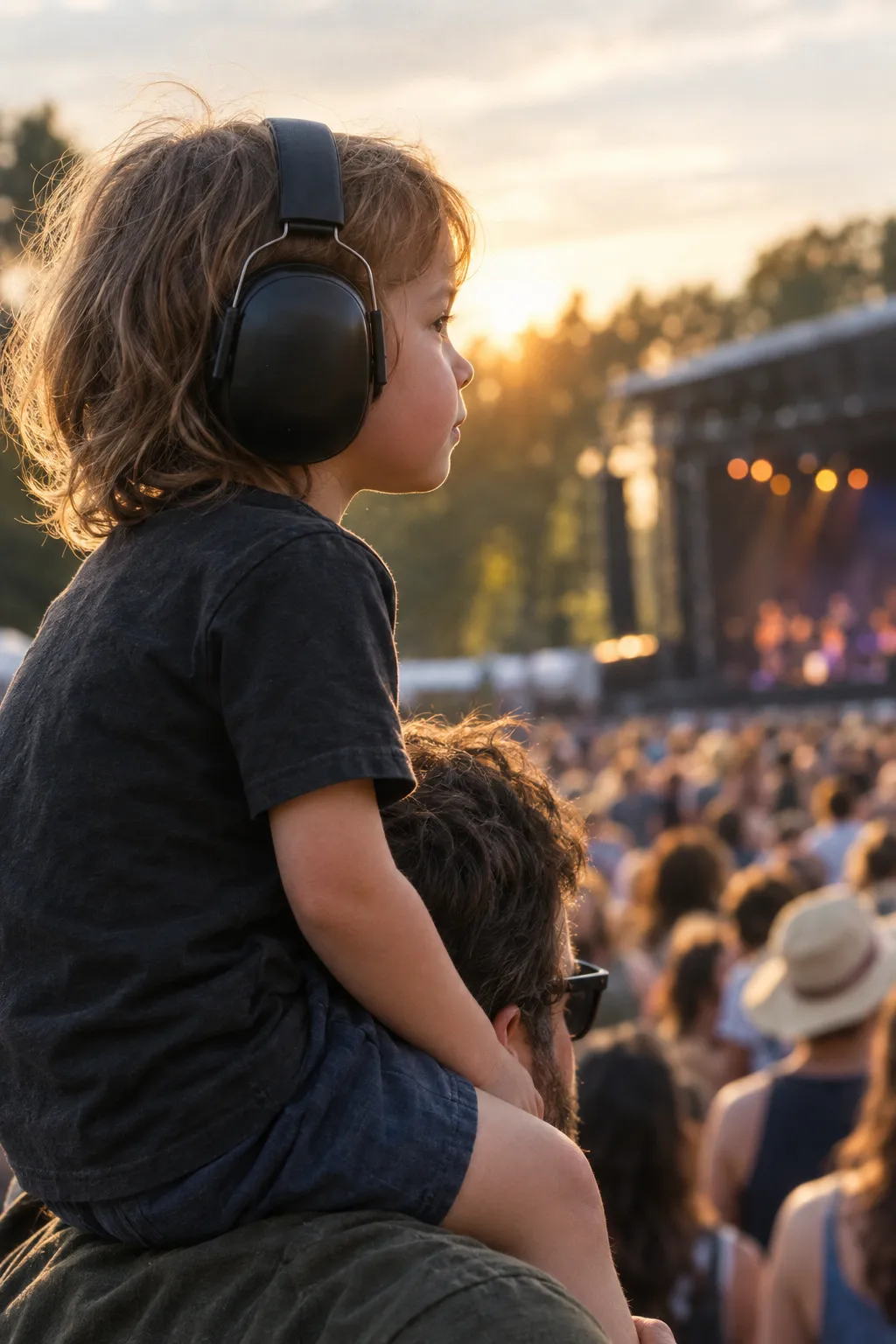
Kids at concerts, games and events
1 QUESTIONAt what age can I bring a child to a concert or game?Asked: “At what age would it be okay to bring a child (infant, toddler, preschool or school age) to a concert or sporting and entertainment event? How long of an exposure (without ear protection)would potentially cause problems for an infant or child?”
Age alone does not make a noisy event safe. Consider the sound level, distance, duration, and whether the child can wear appropriate hearing protection; choose a quieter setting if needed. NIH/NIDCD
Turn the volume down, move away from loud sources, and use hearing protection when loud sound cannot be avoided. Choose a fit appropriate to your child and follow the manufacturer’s instructions rather than assuming one earmuff size suits every child of a given age. NIH/NIDCD
For personal audio devices, WHO–ITU’s children’s mode uses 75 dB for 40 hours per week as a reference sound allowance; it is not a guarantee that every listening situation is safe. WHO–ITU
Phones, tablets and headphones
8 QUESTIONSAre phones and tablets safe for children of all ages?Asked: “Personal Entertainment Devices (i.e. phones, tablets)– Are they safe for children of all ages?”
Sound level and duration matter, including for children. Supervise listening and use device sound-exposure controls rather than assuming a device is safe because it is marketed to kids. WHO–ITU safe-listening standard
How loud are these devices?Asked: “Is there any info that indicates how loud these devices actually are?”
Many phones and tablets can exceed about 105 dB with standard earbuds. At that level, damage can begin in as little as four minutes.
Generally Personal Entertainment Device players including tablets and smartphones can be turned up to a maximum far exceeding 105dB iPhone earphones. It is instructive to note at this level and above hearing damage can occur in as little as four minutes.
Does loudness vary by brand?Asked: “Does loudness vary a great deal from one brand/model to another?”
Output at high volume is about the same across major brands. Only recently have Apple and Android added volume-limit software.
The output levels across brands of models tests are about the same, especially in the high decibel level – Only recently have Apple and Android started providing volume limited software.
Over-ear vs. earbuds: is one safer?Asked: “What about the headphones, over the ear vs. earbuds; one less damaging than the other?”
No. What matters is how loud and how long, not the headphone style.
No – it depends on how loud you set the volume and for how long you listen to that volume.
How loud is too loud when the volume wheel tells me nothing?
If you cannot understand someone speaking normally at arm’s length while listening, it is too loud.
A rule of thumb is if you can not understand someone talking to you in a normal speaking voice when they are an arm’s length away… it is too loud. This rule works with standard earbuds and headphones. If you are using noise-canceling headphones, see the following rule of thumb.
Is there a rule of thumb for the volume wheel?Asked: “Is there a rule of thumb about setting limits on the volume wheel?”
The 60/60 rule: no more than 60% volume for no more than 60 minutes at a time.
Are speakers less damaging than headphones?Asked: “If I am going to crank my music now and then is it less damaging to listen to it thru speakers rather than a personal headset?”
The source does not decide the risk: consider the sound level reaching the ear and how long it lasts. Compare the different exposure guidelines.
Is 50% volume safe?Asked: “I listen to my personal entertainment device at about 50% volume. Is that level safe?”
The WHO estimates 1.1 billion teens and young adults are at risk from personal audio and loud venues. Your Ears Rock suggests the 60/60 rule: 60 minutes a day at 60% volume.
- 1.1 billion teenagers and young adults are at risk of hearing loss due to the unsafe use of personal audio devices, including smartphones, and exposure to damaging levels of sound at noisy entertainment venues such as nightclubs, bars and sporting events. -World Health Organization (WHO)
- Data from studies in middle- and high-income countries analyzed by WHO indicate that among teenagers and young adults aged 12-35 years, nearly 50% are exposed to unsafe levels of sound from the use of personal audio devices and around 40% are exposed to potentially damaging levels of sound at entertainment venues
- Your Ears Rock suggests the 60/60 rule whereby you listen to your headphones or earbuds for no more than 60 minutes per day at 60% volume output
Protection that fits parents & kids
Picked from our catalog to match the situations above. Every product page lists its Noise Reduction Rating.
Compare by situation